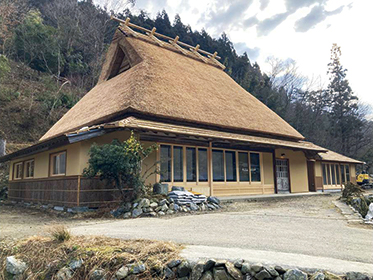
Biodiversity and Natural Capital-related Information Disclosure (Disclosure Based on TNFD Recommendations)
Response to the TNFD recommendations
Biodiversity loss, similar to climate change, could pose a significant threat to the Group’s business foundation. Biodiversity plays a vital role in supporting essential natural resources such as food, water, and air. Corporate activities can have negative impacts through deforestation and land development.
The Group endorses the principles of the Taskforce on Nature-related Financial Disclosures (TNFD)*1 and participates in the TNFD Forum*2. By analyzing in detail our dependencies and impacts on nature, as well as nature-related risks and opportunities, across our entire value chain, we aim to reduce our environmental impacts and create new business opportunities that leverage natural capital.
Furthermore, under the Group’s Environmental Policy, we analyze risks and opportunities related to natural capital in order to fulfill our responsibility to protect the rich natural environment of our communities and pass it on to future generations. This will advance our commitment to nature positivity and contribute to the realization of a sustainable society.
- *1An initiative that provides an international framework for companies and financial institutions to assess and disclose risks and opportunities related to the loss of natural capital and biodiversity.
- *2An international organization in which companies, financial institutions, academic institutions, NGOs, and others participate to discuss and share methods for assessing and disclosing risks and opportunities related to natural capital.

Analysis of the relationship between each sector and natural capital
To identify nature-related risks and opportunities, we utilized the ENCORE tool for nature-related dependencies, impacts, and risk analysis recommended in the TNFD framework. We analyzed the dependencies and impacts on natural capital for each sector within our business loan portfolio in Kyoto Prefecture, our main operating area.
Identification of important sectors
Kyoto, which served as a capital for one thousand years, is a region where long history and cutting-edge technology resonate together, continuously creating new value. Tourism, one of the main industries, has a very large economic impact, with the number of tourists* reaching 91.47 million and tourism spending* totaling ¥2,255.9 billion in 2025. The diverse related industries that support tourism, such as accommodation, food service, food manufacturing, distribution, and agriculture, work closely together and function as an ecosystem.
Taking these regional industry characteristics into account, we used analysis with ENCORE to identify key sectors in our portfolio by combining “dependency” and “impact” scores for 11 major sectors.
The analysis revealed that the sectors with the highest degree of dependency and impact were consumer goods and services (hotels, resorts, restaurants, etc.) and consumer staples (food retail, food distribution, agricultural products and services, etc.). Going forward, we will further improve the accuracy of our analysis to identify sectors and natural capital that require priority response.
- *Source: Kyoto Prefecture, “2025 Number of Visitors and Tourism Consumption in Kyoto Prefecture&”
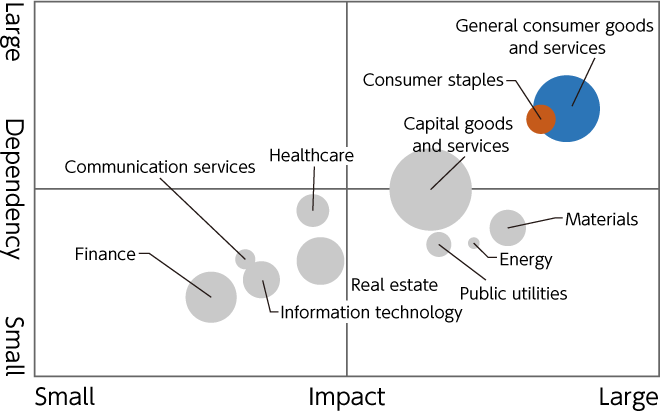
- *The larger the size of the circle, the larger the investment amount.
ENCORE analysis results of identified sectors
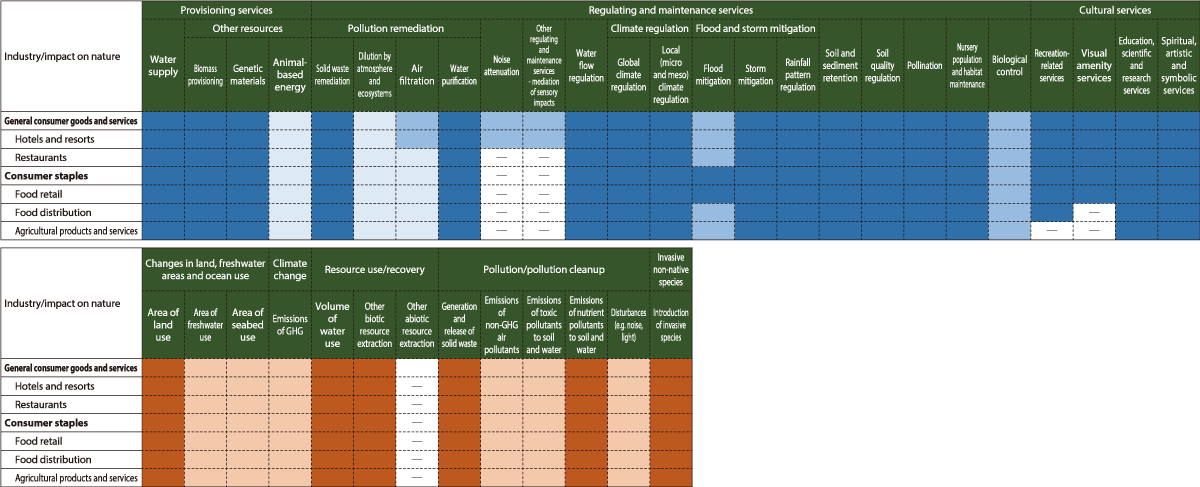

- *Items highlighted in darker colors indicate a high degree of dependency or impact.
Dependencies and impacts on natural capital in identified sectors
The identified sectors are heavily dependent on local natural capital, and this dependency is particularly pronounced in the areas of general consumer goods and services and consumer staples. Hotels, resorts, restaurants, and other services in Kyoto offer unique value to visitors by utilizing the scenery of the four seasons, the historical streetscapes, and distinctive local ingredients. Locally harvested Kyoto vegetables, sake made with pure groundwater, and matcha green tea are also important elements for experiencing the region’s rich culture and traditions. Furthermore, the production of these ingredients relies heavily on the local climate and soil, as well as the water resources of over 300 rivers, highlighting the need for sustainable resource utilization.
However, these industrial activities also present challenges, including environmental impacts. For example, the process of providing tourism and related services generates a large amount of food waste and packaging materials, and if these are not properly disposed of, they can put a strain on the local environment. The increase in waste poses a risk of landfill shortages and environmental pollution, making recycling and waste reduction efforts essential.
Furthermore, the food distribution and retail industries need to address increased greenhouse gas emissions due to higher energy consumption and water resource use, requiring sustainable use and management.
Addressing these challenges is essential to protecting the local natural environment and cultural landscape, and in the long term, to maintaining tourism resources and the region’s appeal. We will support these sectors in implementing sustainable management strategies to minimize their environmental impacts.
Examples of initiatives for the conservation of natural capital and biodiversity
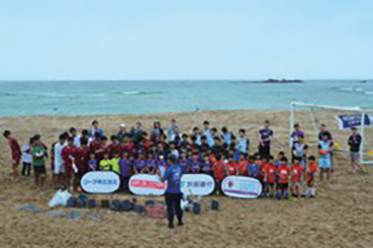
Regarding biodiversity conservation activities, we participate in volunteer work aimed at forest maintenance and local environmental conservation. Furthermore, the Bank of Kyoto, as the top sponsor of Kyoto Sanga F.C., also supports the Hatchohama Beach Cleanup hosted by the team, where we conduct special lectures on marine debris and beach clean-up activities for elementary and junior high school students, striving to raise awareness about marine debris issues such as marine plastics.
We are also focusing on promoting biodiversity conservation efforts through our business activities, such as investing in venture companies that are engaged in biodiversity conservation through funds managed by Kyoto Capital Partners.
By continuing and further developing these initiatives, we will contribute to the realization of a nature-positive society.
(c) KYOTO P.S.
Considerations for local communities and the environment based on a circular economy
Based on the principles of a circular economy, we aim for a sustainable society by promoting waste reduction, forest management, plastic elimination, and local production and consumption.
Reuse of internal documents
Reducing waste is a crucial element of the circular economy. Although the Group is working towards a paperless environment, we still discard approximately 400 tons of internal documents annually. We recycle these paper wastes into toilet paper after confidential treatment and donate them to public elementary, junior high, and special-needs schools in Kyoto and Shiga prefectures. This initiative has been ongoing since 2001, and to date, we have donated a total of approximately 6.5 million rolls of toilet paper. This promotes a circular economy, where waste is recycled as a resource.

Restoration and utilization of old private houses
With the aim of efficiently utilizing local resources and realizing a sustainable society, the Group promotes the restoration and utilization of old private houses. As a result, we are working to establish a fund to support local community development and to promote the circularity of old private houses. The Kyogin Community Development Fund Limited Liability Partnership (Kyogin Community Development Fund) invests in projects that renovate old private houses, vacant shops, and empty public facilities into accommodation, commercial, and socializing facilities, thereby contributing to the revitalization of the local economy by repurposing old private houses and vacant properties in the community for new uses.